A reputation audit always surfaces more findings than can realistically be addressed: a legitimate but invisible executive, a positioning that is hard to grasp, contradictory messages, genuine but undocumented expertise, a past that still takes centre stage. When combined with an audit of company data, it also uncovers valuable but inaccessible information. The gaps behind each of these findings affect how the company is understood by its audiences, by search engines and, increasingly, by AI.
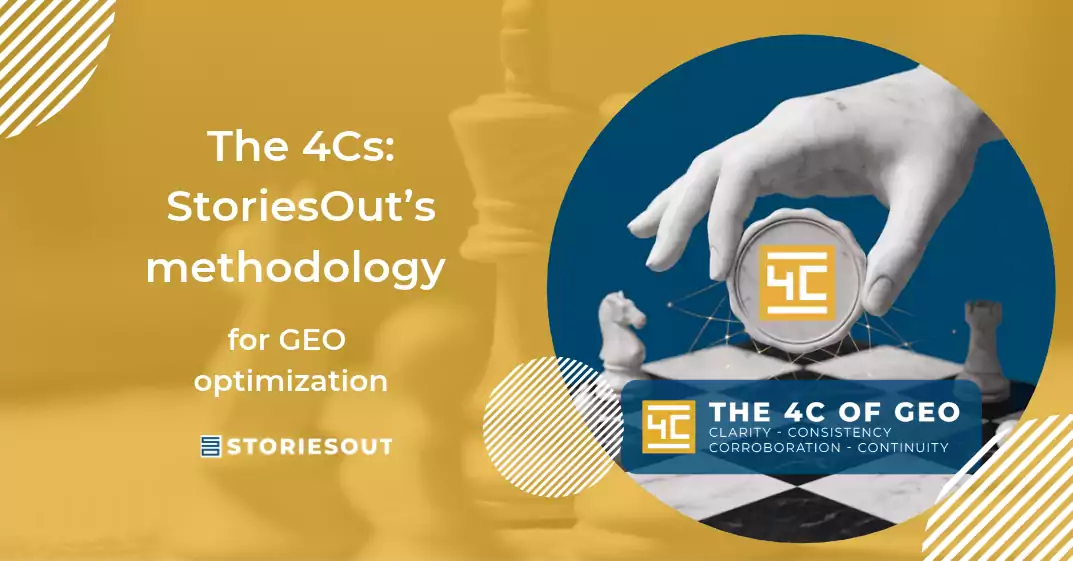
The challenge is not listing them, but turning them into a prioritised action plan. To do so, StoriesOut applies the 4Cs method, formalised by Manuel Singeot. It identifies what needs to be corrected or strengthened before choosing which levers to pull. It also helps build the foundation of a lasting reputation: its narrative capital.
Four questions to establish the diagnosis
- Clarity: is what the company wants to convey genuinely understandable?
- Consistency: does the available information describe one and the same company?
- Corroboration: do facts, data or third-party sources support its claims?
- Continuity: is this representation maintained and updated over time?
Each audit finding is linked to one of these questions. This takes us from a finding to an information problem, then to an objective, and finally to actions. Every recommendation addresses an identified problem, not simply a desire to communicate more.
An example
Take the following case: a mid-sized company has repositioned itself in industrial cybersecurity, yet most of its press coverage and older web pages still describe its legacy business. Two problems emerge:
- Consistency: narrative debt is blurring the new positioning.
- Corroboration: no third-party source documents the new expertise yet.
If the objective is to make the new expertise the company’s dominant representation within 12 months, several coordinated actions are required:
- GEO: updating and contextualising legacy pages.
- Influence: establishing the CEO as a voice on industrial site security.
- PR: a sector study based on internal data, pitched to specialist media.
What each C leads us to recommend
Clarity.
A company can master its business perfectly and still be hard to understand from the outside: overly complex positioning, pages with multiple objectives, inconsistent terminology. Recommendations then focus on rewriting pages, the boilerplate, message hierarchy or defining a semantic field. The principle: one idea, one sentence; one page, one purpose.
Consistency.
Website, past publications, executive statements, press articles, partner pages, AI-generated answers: each can present a different version of the same company. The task is to identify contradictions, particularly narrative debt, those outdated representations that continue to weigh on perception. Content and thought-leadership territories must then be aligned.
Corroboration.
Claiming to be an expert, an innovator or a market leader does not make it so. Recommendations aim to make data accessible, develop customer case studies, produce research or work on a topic with the media. The goal: no longer just to say, but to enable others to see for themselves.
Continuity.
A reputation does not change at the pace of a website redesign. Establishing expertise or displacing an outdated image takes months. Continuity turns actions into a trajectory: what can happen immediately, what needs to build up over time, and what the whole effort must gradually achieve.
The problem first, the levers second
A single problem rarely calls for a single lever. In the example above, a Consistency and Corroboration gap involves GEO, influence and media relations at the same time. This is why StoriesOut starts from the problem before choosing the lever. The agency combines these disciplines according to what the situation requires, not according to the internal logic of each one.
From one-off communications to narrative capital
A piece of press coverage, a web page, a study or an executive’s intervention has an immediate effect. Their value grows as they add up. This accumulation forms a company’s narrative capital: the facts, evidence, recognised expertise, data, public statements and third-party validations on which its reputation can rest.
The 4Cs give StoriesOut a framework to identify this capital, decide what needs strengthening and choose the levers that contribute to it. In other words, to move from a series of communications actions to building a reputation.