AI & Reputation Management
Your customers have questions. They are looking for a solution to a problem, comparing different options, trying to understand a market or identify the company best equipped to meet their needs.
Before the rise of LLMs, they would ask Google, browse through a few results and visit the websites of companies that seemed relevant. For more specific searches, they might continue on LinkedIn, read press articles, expert studies and testimonials, or use a comparison website.
The context has changed. Search can now also take the form of a question asked to ChatGPT, Gemini, Perplexity or another generative engine. And with these tools, visibility is no longer enough. You need to provide the right information, in the right format, so that they can use it in their answers and cite you, or even recommend you.
Your customers are not necessarily looking for your company
This is the first principle to keep in mind. A prospect who already knows your name can search for it directly. But someone who does not yet know you is not looking for your product. They are looking for an answer to their problem. The questions they ask focus on the problem rather than the solution: they are user-centric.
And this is precisely how AI tools operate: they are not designed to push a product or service, but to answer questions. Those questions therefore define your semantic territory: the range of topics, problems, areas of expertise, concepts and needs with which your company needs to be associated.
The user-centric approach predates LLMs. SEO has long taught companies to work across semantic territories rather than focus on isolated keywords. But the importance of these territories now extends far beyond search engine results pages.
The same territories should structure the content your customers encounter, the topics on which journalists seek expert voices, your executives’ thought leadership and the information available to AI systems trying to understand your company.
Occupying a territory therefore means making your company identifiable whenever a question related to its expertise is asked.
Occupying a territory does not mean publishing more
Faced with a growing number of search and information environments, the temptation is obvious: publish more posts and secure more media coverage. But accumulating content does not necessarily build a reputation.
A company can publish extensively and still be difficult to understand. It can discuss ten different topics without becoming clearly associated with any of them. It can claim expertise on its website without any external source confirming it.
It can even continue producing information that reinforces an outdated perception of its business long after its positioning has changed.
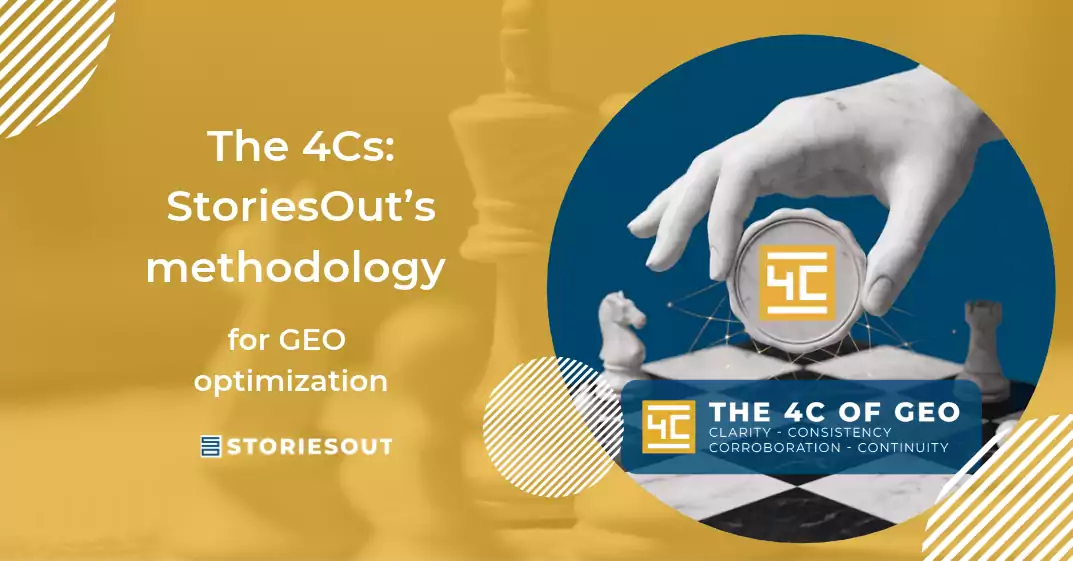
The problem is no longer a lack of information, it is how that information is organised. To genuinely contribute to a company’s reputation, information needs to meet four
requirements: Clarity, Consistency, Corroboration and Continuity: the 4Cs.
It needs to be understandable. It needs to describe the same company consistently over time and across different channels. Claims need to be supported by facts and third-party sources. And that presence needs to be sustained long enough to become identifiable.
Publishing is a means to an end. The objective is to build a coherent representation of the company.
The Core Narrative gives structure to your territory
There is still one challenge: a company rarely has a single area of expertise, a single product or a single message. So how do you avoid spreading your communication too thinly?
This is the role of the Core Narrative. It is the central narrative around which a company’s communications are organised: what it does, the problems it solves, what sets it apart, the expertise it wants to make visible and the evidence that makes that expertise credible.
This is not storytelling for storytelling’s sake. The Core Narrative is an architecture. It connects a website page with a blog post, a contributed article in the press, an independent study, an executive interview, a customer case study and a LinkedIn post.
Each piece of content can have its own angle. Each channel retains its own conventions. Together, they contribute to building the same representation of the company.
That consistency matters to your audiences. It matters to search engines. And it becomes essential for AI systems that need to reconstruct what an organisation does from the information available to them.
Your website cannot answer alone
A company is obviously the primary source of information about itself. Its website should clearly explain what it does, who it serves, how it works and where its expertise lies.
But the company cannot be the only one saying it. Writing “we are experts in…” is simply a claim.
Publishing data that can be challenged, verified and confirmed provides evidence. When that expertise is cited by a media outlet, recognised by a customer, embodied by an executive or referenced by an independent source, it takes on another dimension: it gains external validation and, with it, credibility.
This is where PR and influence play an essential role. PR is no longer simply about gaining visibility. It contributes to building credibility that cannot simply be declared internally: it needs to be corroborated by independent voices.
Likewise, influence is no longer simply about building an audience. It should enable experts, executives, employees and partners to embody the company’s knowledge and convictions.
- The website explains.
- Content develops the expertise.
- People embody it.
- Third parties corroborate it.
Together, they build credibility.
And now AI answers too
Artificial intelligence did not invent this mechanism. It simply makes it much more visible. When users ask a traditional search engine for a solution to a problem, it primarily offers them resources to consult.
When they ask a generative AI the same question, they can receive a direct, synthesised answer: an explanation, a selection of companies, a comparison and, sometimes, a recommendation.
The difference is significant. Instead of placing a link among a list of websites that might contain the answer, AI constructs a relevant response from the information available to it. To do so, it needs to understand what your company does, identify its areas of expertise and find enough supporting evidence to corroborate them.
GEO aims to identify the information required for that understanding: what already exists, but also what is missing or contradictory, before guiding its production and distribution in the right places.
This enables AI systems to reconstruct a representation of the company and select the information they need to answer users’ questions.
Far from being limited to producing “content for ChatGPT”, GEO therefore provides a framework for diagnosing, coordinating and measuring the information environment from which generative systems construct their answers.
PR, influence, SEO and GEO all work on the same asset
Faced with this new reality, StoriesOut believes the most effective response is to use these different disciplines together to build the credibility companies now need.
Historically, SEO has focused on presence in search engines, PR on building a company’s presence in the media, and influence on using people and thought leadership to embody its expertise and positions.
GEO could therefore simply become the discipline responsible for communicating with AI.
But treating these different components of a company’s narrative capital as separate silos can quickly create inconsistencies in its overall narrative.
The opposite approach is far more powerful.
A press article can strengthen a company’s reputation, help it surface in Google Search, fuel a conversation on LinkedIn and provide a source that helps an AI system better understand its expertise.
Similarly, proprietary research can become SEO content, provide a PR angle, support an executive’s thought leadership and generate evidence that corroborates expertise.
And a well-chosen customer case study can substantiate a commercial promise, answer a prospect’s specific question and provide concrete evidence of what the company can actually do.
The logic of a non-siloed strategy therefore becomes clear: every aspect of corporate communication should contribute to building its narrative capital.
- Your website says who you are.
- Your content explains what you know.
- Your spokespeople embody it.
- Third parties corroborate it.
- Search engines and AI systems have the information they need to infer a coherent representation.
So, who answers your customers?
Until recently, Google’s search results remained the dominant gateway to online information about your company. The arrival of AI Overviews made the shift particularly tangible: AI-powered search now provides direct answers to the problems your prospects are trying to solve.
Does your company still appear in their search environment? Can they quickly understand what you do and what makes you different?
Do they encounter the same company on your website, in your content, through your executives’ thought leadership and in external sources?
Is the expertise you claim sufficiently documented and corroborated?
And when an AI system needs to answer those questions, does it have enough reliable information to put your company forward or will it find better evidence about your competitors?
Make no mistake: your customers will continue asking questions on Google, turning to their peers and social networks such as LinkedIn, and increasingly asking artificial intelligence.
You will never have complete control over the answers they receive.
But you can build the information environment from which those answers are produced.
This is StoriesOut’s conviction: doing so requires carefully coordinating communication channels that once operated relatively independently but must now follow a coherent strategy and work towards a common goal, strengthening your company’s narrative capital, which AI systems draw on to answer your customers’ questions before they ever contact you.