
Each and every time we talk about the Narrative Capital concept, it hits a nerve. It was time we proposed a dedicated user guide for it.
What narrative capital is
Narrative capital is the value a brand draws from its narrative: what it declares, what others say about it, and what those who judge it take away. Those judges are customers, journalists, employees, and now AI.
Like any capital, it is built up, it has a balance and it can be measured. It can be in credit or in debt. And it can be managed, provided you know how to read it.
Its composition: three sources
Narrative capital is built from three sources. Only one is fully controlled by the brand.
- The narrative that the brand produces and declares: mission, positioning, corporate communications
→ usually, it is controlled by the brand – the pitfall lies in the proliferation of touch points (and therefore in maintaining consistency) - Third-party recommendations: everything that the media, employees, customers and communities say about the brand.
→ It is possible to influence this aspect, particularly through press relations. Be aware that inertia can be strong (except in the event of a crisis; I’ll come back to this) - Ambassadors: the way in which spokespersons convey and embody the narrative.
→ They must, of course, be trained in both substance and style. Unfortunately, this need for training is often underestimated, sacrificed on the altar of ‘no, but they’re an excellent speaker’ … when that is absolutely not the point.
Its balance: the gap between what is declared and what is perceived
Narrative Debt and Credit
The narrative balance is the gap between what the brand declares and what is perceived, then relayed, by third parties, ambassadors and AI.
- Narrative credit: perception lives up to the narrative, or exceeds it.
- Narrative debt: perception falls short, or is blurred or contradictory.
This gap is read on two independent axes.
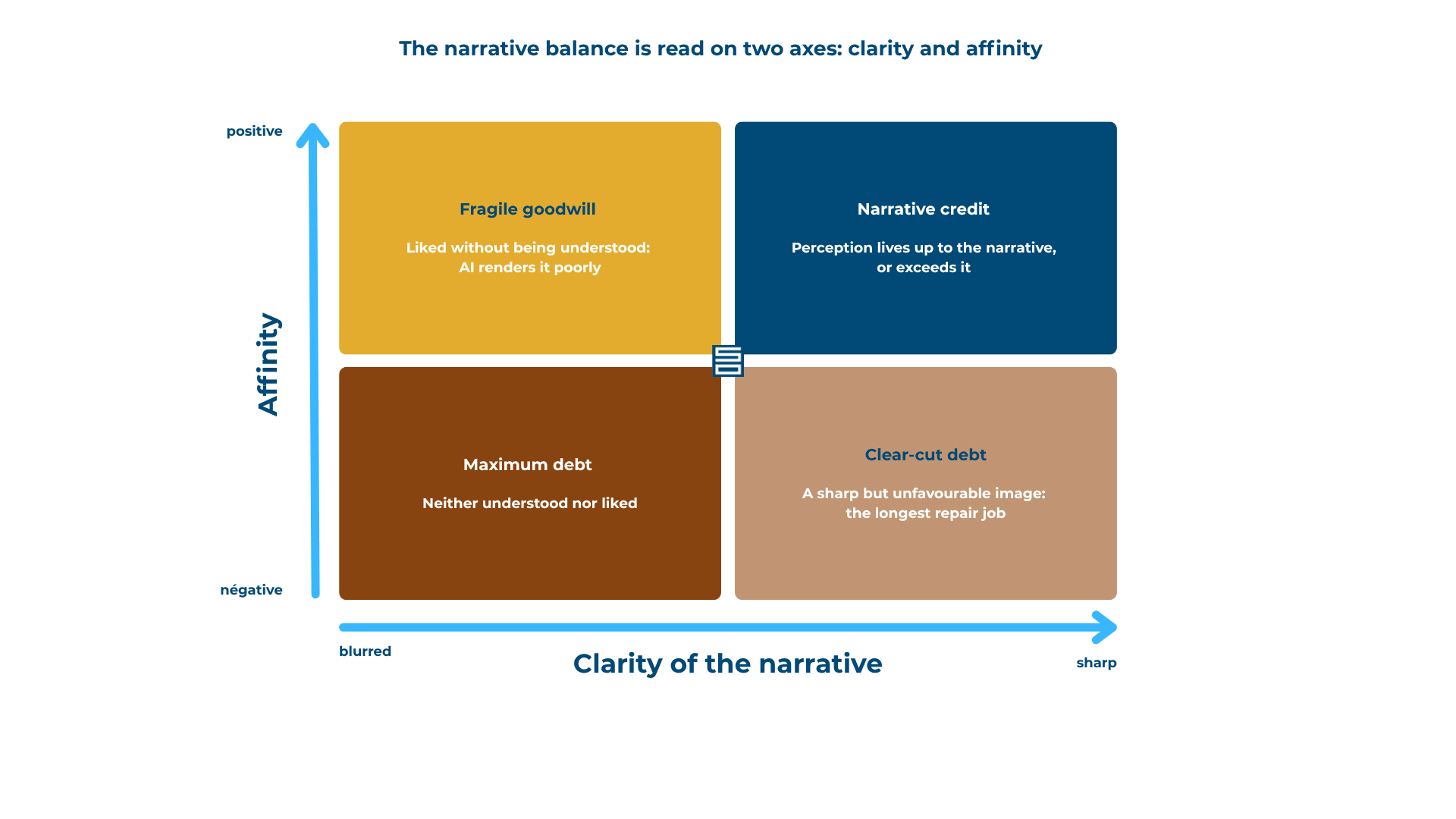
Clarity: is the narrative legible?
- Is the narrative unambiguous? A brand confused with another, or described in several ways, builds up debt.
- Is the narrative easy to find? For people, and for AI, which must be able to read it and attribute it correctly.
- Consistency over time. Does the narrative hold from one statement to the next, from one year to the next?
- Consistency across space. Is the same thing said online and offline: on the website, at trade shows, in stores, by spokespeople?
Affinity: is the narrative liked?
- Positive or negative, generous or stingy, inspiring or indifferent. These descriptors form a semantic field, which can be compared with the field the brand is aiming for.
A brand can be clear yet disliked, or liked yet blurred. These are neither the same debts nor the same remedies.
Crisis, the moment of truth for the balance
A crisis is when a brand draws on its narrative capital. Credit cushions the shock: the brand gets the benefit of the doubt. Debt amplifies it: the crisis confirms what people already suspected.
Crises have three origins, and they are not judged the same way.
| Origin | Examples | What is put to the test |
| The company’s own doing | Product, labour relations, CSR, governance, etc. | The narrative: is the promise kept? |
| A spokesperson’s doing | An ill-judged or uncoordinated statement | The ambassadors: are they trained and aligned? |
| An external event | Industry crisis, context, disinformation, confusion with another brand | The response alone: the brand is not responsible, but it is judged on how it reacts |
The response is read on the two axes of the balance.
- Clarity: speed, unambiguous messaging, consistency across spokespeople and channels. Three voices saying three different things create instant debt.
- Affinity: empathy or defensiveness, generosity or stinginess. A crisis is often when a brand reveals what it really is.
The right response can turn a crisis into credit.
AI, for its part, has a long memory. Months later, it may still associate the brand with the incident without mentioning how it was resolved. The post-crisis phase is therefore also a disambiguation effort: publish the resolution, get third parties to relay it, check what AI retains.
Its measurement: two readers, one value chain
In the end, it is the brand’s economic performance that settles the matter. But it depends on too many factors to steer by. It is linked to narrative capital through a three-step chain.
- Leading indicators: what people and AI read. They make it possible to act fast.
- Intermediate indicator: traffic, digital and physical, to the brand.
- Final indicator: economic performance. It validates over time.
Two audiences read narrative capital, each with its own units of measurement.
| Reader | Units of measurement | What they reveal |
| People | Customer reviews · pickup of the corporate narrative · relays by ambassadors | The state of each of the three sources (narrative, third parties recommendations, ambassadors) |
| IA | Citations · recommendations · accuracy of the description | The synthesis of the three sources, as it is relayed |
Citations and recommendations measure volume. Accuracy measures quality: does AI describe the brand the way its narrative intends? That is where disambiguation plays out.
AI is therefore not a source of narrative capital. It is what reveals it: the place where the balance becomes visible and measurable.
In times of crisis, four markers complete the picture:
- response time;
- consistency of messages across spokespeople and channels;
- the shift in sentiment before and after the crisis;
- how long AI keeps associating the brand with the incident.
The virtuous loop
Narrative capital is not a state but a flow: every statement feeds it or erodes it. Managing it means keeping a loop turning.
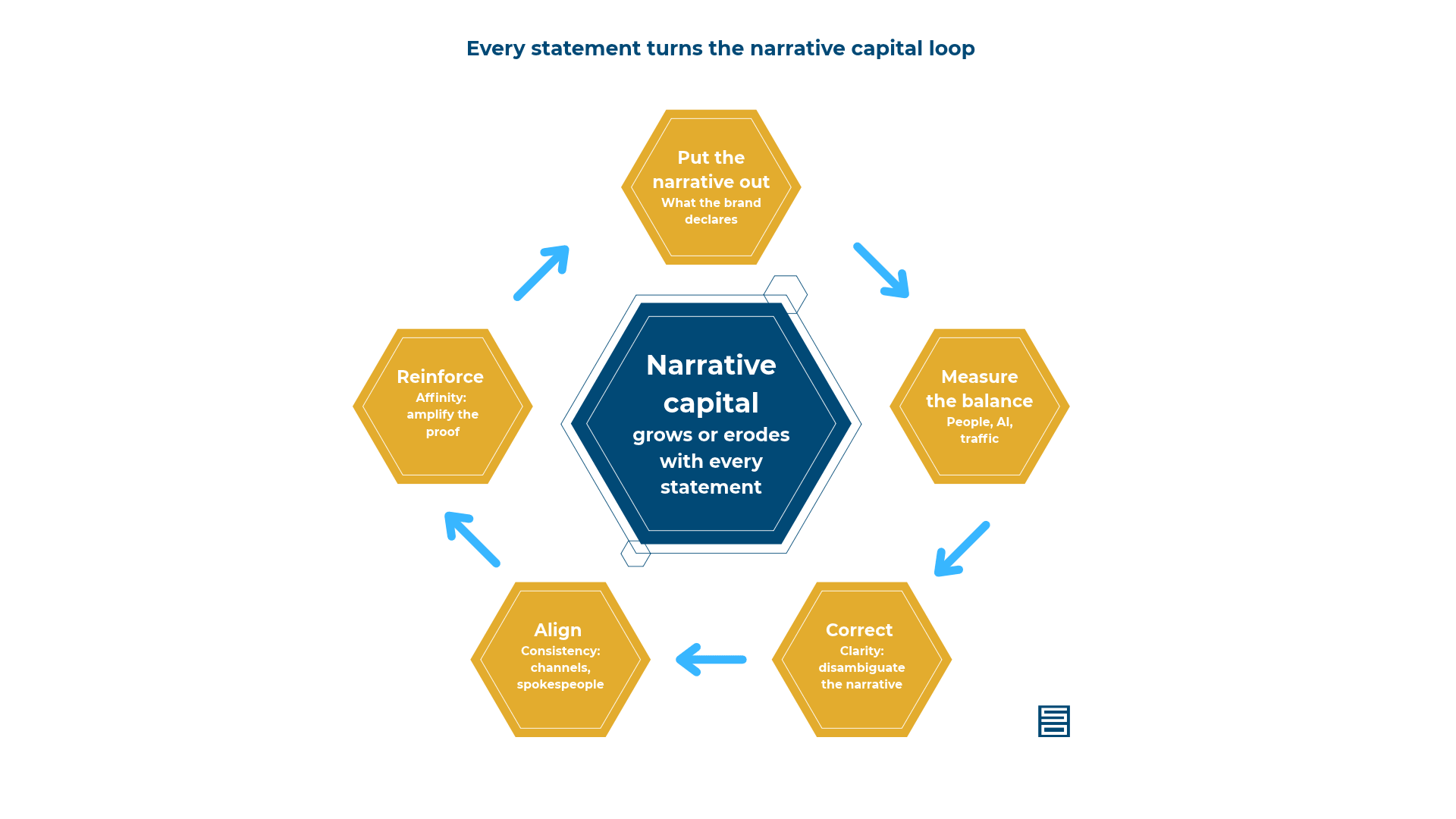
Correcting acts on clarity, aligning on consistency, reinforcing on affinity. Each turn narrows the gap between what is declared and what is perceived.
Our proposal: managing narrative capital as an asset
StoriesOut invites communications departments to treat narrative capital as an asset on the balance sheet: establish its opening balance, track it over time and grow it through actions whose effect can be seen.
Roadmap
- The initial audit. A diagnosis that establishes the starting balance.
- Define, with leadership, the target semantic field: the words by which the brand wants to be described.
- Measure the field actually used by the media, customers and employees, and what AI says about the brand.
- Place the brand on the two axes, clarity and affinity.
- Identify the sources of debt: ambiguities, inconsistencies across channels, misaligned spokespeople.
- The dashboard. Leading indicators, tracked over time.
- The gap between the target field and the observed field.
- Citations, recommendations and accuracy in AI answers.
- The tone of reviews and media coverage, and relays by ambassadors.
- How these line up with traffic and the economic indicators the brand already tracks.
- The action plan. Each action is tied to a source and a lever.
- Press relations: endorsement by third parties.
- Influence and spokesperson training: alignment of ambassadors.
- GEO-SEO: accessibility and disambiguation of the narrative, for people and for AI.
- Crisis preparedness. Drawing on the capital when it matters most.
- Train spokespeople to speak in a crisis.
- Keep a reference narrative ready, to respond fast and with one voice.
- Prepare scenarios by crisis origin: company, spokesperson, external event.
- After the crisis, monitor AI answers until the resolution appears in them.
- The periodic review. Measure again, adjust: the loop keeps turning.
What the communications department gains
- A shared language with the CEO and the CFO: a capital, a balance, a trend.
- Proof of the impact of its actions, beyond the volume of coverage.
- A clear view of what AI says about the brand, now a touchpoint in its own right.